For many Michigan small and midsize businesses, hiring a full-time chief information security officer sounds ideal: but the cost, recruiting challenge, and organizational complexity can place it out of reach.
That does not mean your business must operate without security leadership.
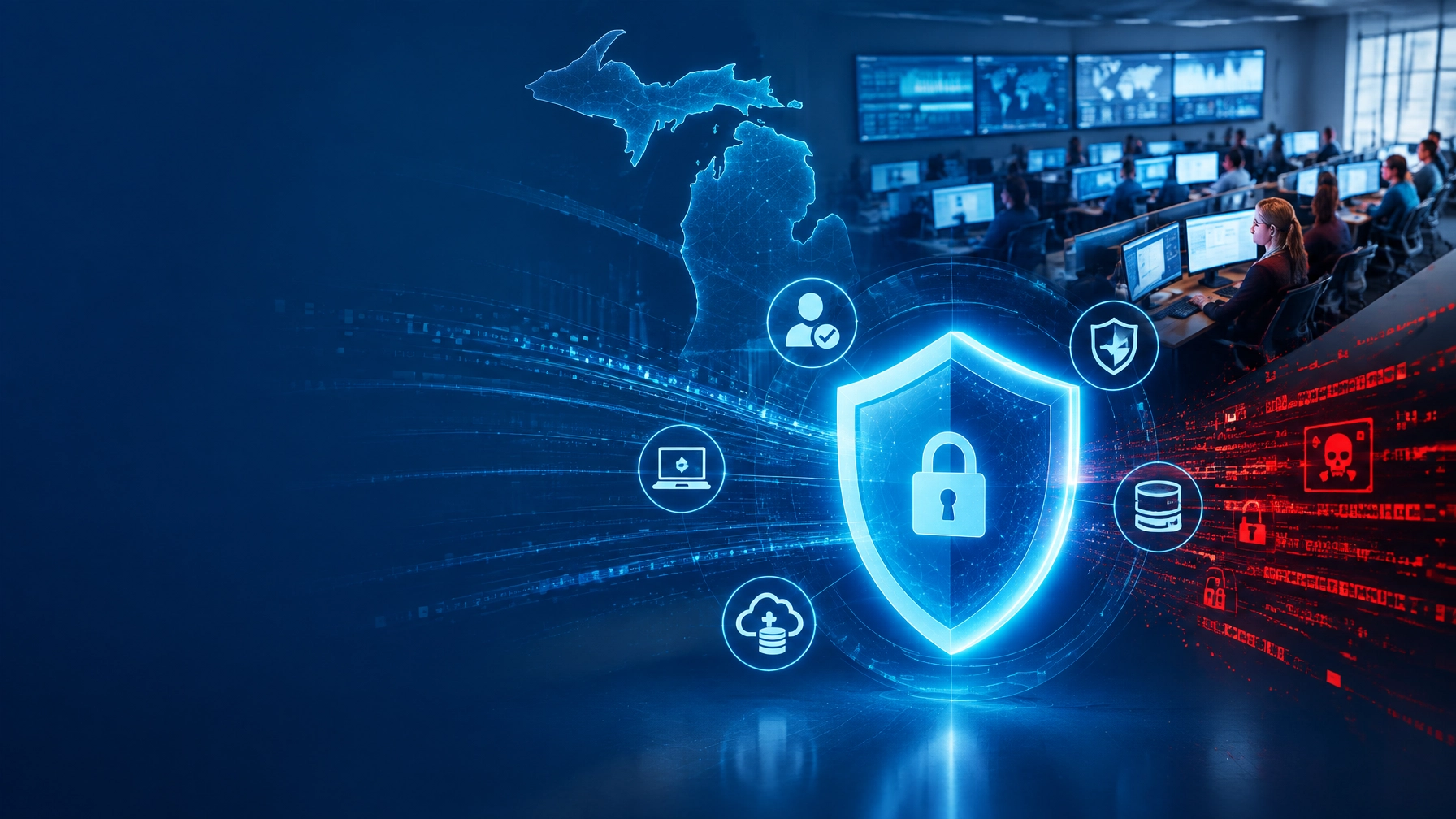
In 2026, MDR-style managed protection gives SMBs a practical alternative. By combining 24/7 monitoring, managed detection and response, virtual CISO guidance, security reporting, compliance documentation, and human escalation, you can access enterprise-grade protection without building an entire internal security department.
This is not about buying another security tool and hoping someone checks the alerts. It is about creating a coordinated protection program that watches your environment, reduces exposure, documents its work, and brings experienced people into the conversation when decisions matter.
“You do not need to build an enterprise security department to achieve enterprise-level discipline. You need the right people, processes, and protection working together.”
Start by Understanding What MDR-Style Protection Means
Begin with the distinction between security software and managed security services.
Endpoint detection and response tools can identify suspicious activity on computers and servers. Email security can block malicious messages. Identity controls can help prevent unauthorized access. These technologies are valuable, but they do not automatically investigate every alert, determine business impact, contain a threat, or explain what happened to leadership.
Managed detection and response, commonly called MDR, adds continuous oversight and response processes around those technologies. A security operations team monitors activity, investigates suspicious behavior, prioritizes risk, and takes or recommends action according to an agreed response plan.
MDR-style managed protection expands that model to include the strategic guidance many businesses associate with a CISO. That may include:
- Security risk assessments
- Executive-level reporting
- Policy and procedure development
- Incident response planning
- Cyber insurance preparation
- Compliance documentation
- Vendor and access reviews
- Security awareness recommendations
- Long-term cybersecurity roadmaps
The goal is not simply to generate more alerts. The goal is to create accountability around what those alerts mean and what your business should do next.
For a useful foundation, review ClearPath360’s guidance on comprehensive cybersecurity for modern businesses.
Next, Compare the “Do It Alone” Model With Managed Protection
Use this comparison to assess your current approach honestly.
When a small business manages cybersecurity alone, security tasks often fall to an owner, office manager, IT generalist, or already-overloaded employee. That person may be responsible for reviewing alerts between meetings, updating policies when time allows, and responding to suspicious activity after someone notices a problem.
This model creates predictable weaknesses:
- Alerts may sit unattended overnight or over a weekend.
- Security decisions may depend on one person’s availability.
- Documentation may be incomplete or inconsistent.
- Leadership may not receive a clear picture of current risk.
- Compliance evidence may be difficult to assemble.
- Incident response may begin without defined roles or priorities.
Doing it alone can appear less expensive until you account for missed alerts, downtime, lost productivity, regulatory exposure, and the cost of making high-pressure decisions without experienced support.
Now compare that with MDR-style managed protection. A qualified provider can monitor systems continuously, use automation to speed up triage, involve human analysts for investigation, and escalate serious matters according to documented procedures. Your internal team still makes business decisions, but it does not have to interpret every technical signal by itself.

The distinction is important: managed protection does not remove your responsibility. It gives you a stronger operating structure for meeting that responsibility.
Build the Program Around Human Escalation
Automation is essential for speed, but it should not be the only layer between your business and a serious cyber incident.
Begin by asking a prospective provider how escalation works. Do they simply forward alerts to your inbox, or does a security analyst investigate the event first? Who contacts your leadership team when a threat could affect operations? What happens if a device must be isolated, an account must be disabled, or systems must be taken offline?
A strong MDR-style program should define:
- Which events receive immediate attention
- Which response actions the provider can take automatically
- When human analysts investigate and validate a threat
- Who receives a call or urgent notification
- How incidents are documented after resolution
- How lessons learned become future improvements
This is where human judgment adds value. Automated systems can identify unusual login activity, malicious files, or suspicious network behavior quickly. Experienced analysts can connect those signals, assess context, reduce false positives, and determine whether the activity requires containment.
Your provider should also help create practical incident runbooks. A manufacturing company may need different escalation procedures than a medical practice, professional services firm, or financial organization. Keep the plan aligned with your operations, decision-makers, and tolerance for disruption.
Add vCISO Guidance Without Hiring a Full-Time CISO
A virtual CISO, or vCISO, provides security leadership on a fractional or shared basis. Instead of adding a full-time executive to your payroll, you gain access to strategic guidance when and where your organization needs it.
Use this layer to connect technical activity with business priorities.
A vCISO-style engagement can help you:
- Maintain a current security risk register
- Prioritize remediation based on business impact
- Establish security policies and procedures
- Prepare for customer security questionnaires
- Organize cyber insurance documentation
- Coordinate tabletop exercises
- Review third-party technology risks
- Present security priorities to business leadership
- Build a phased improvement roadmap
For example, an MDR report might identify repeated failed logins against a privileged account. The security team can investigate and contain the activity. A vCISO then helps ask the larger questions: Is multifactor authentication enforced everywhere? Are privileged accounts reviewed regularly? Does the access policy reflect current staffing? Should leadership fund additional identity protection?

That combination turns isolated alerts into measurable security improvement.
Treat Reporting and Compliance Documentation as Business Assets
Security reporting should do more than show a list of closed tickets.
Ask your provider to deliver reports that explain what was monitored, what was detected, what actions were taken, what risks remain, and what decisions should come next. Leadership needs concise information, while technical teams may need deeper details for remediation and investigation.
Useful reporting may include:
- Executive security summaries
- High-risk findings and recommended actions
- Incident timelines
- Response and resolution records
- Patch and vulnerability status
- User and identity risk trends
- Backup and recovery verification
- Security awareness activity
- Open risks and assigned owners
Documentation also supports conversations with customers, insurers, auditors, and regulators. The FTC Safeguards Rule, for example, emphasizes the importance of a written information security program and ongoing safeguards for covered organizations. MDR does not automatically make a business compliant, and no provider should promise that it does. However, documented monitoring, response procedures, risk reviews, and security reports can help demonstrate that your organization is managing security deliberately.
As you review requirements, use the documentation process to expose gaps: not to create paperwork for its own sake.
Choose an Integrated Partner Instead of Another Isolated Tool
This is where ClearPath360’s 360-degree approach matters.
A business does not experience technology risk in separate categories. A compromised identity can affect email, cloud applications, endpoints, and physical operations. A network outage can interrupt security systems and business workflows at the same time. A surveillance system connected to an unsecured network can introduce risks that a traditional IT-only provider may overlook.
ClearPath360 integrates managed IT and cybersecurity as part of one proactive protection strategy. That approach can include system reliability, cybersecurity controls, monitoring, planning, and transparent communication through a coordinated relationship.
Explore how 360-degree IT solutions support business growth, or review the warning signs that it may be time to move beyond traditional break-fix IT support.

The benefit is not simply convenience. It is shared context. Your technology partner can understand how infrastructure, users, security controls, physical systems, and business goals fit together.
Take the Next Step Toward Always-On Protection
Begin by documenting your current state. Identify who monitors alerts, who handles incidents, how often leadership receives reports, and where compliance evidence is stored. Then ask whether your current approach would perform effectively at 2 a.m. on a holiday weekend.
If the answer is uncertain, MDR-style managed protection may be the practical next step.
Look for a partner that can provide:
- Continuous monitoring and threat response
- Clear human escalation procedures
- vCISO-level strategic guidance
- Actionable executive reporting
- Compliance-ready documentation
- Proactive managed IT support
- Scalable services aligned with your budget
- Transparent communication from knowledgeable experts
ClearPath360 helps Michigan businesses build resilient technology environments without the complexity of managing every security function internally. Our integrated approach is designed to prevent problems, improve visibility, and give decision-makers confidence in the systems that support their business.
“The strongest security program is not the one with the most tools. It is the one your people understand, your provider actively manages, and your business can sustain.”
Contact ClearPath360 to request a personalized assessment and discuss a practical roadmap for managed IT, cybersecurity, reporting, and 24/7 protection. Your business may not need a full-time CISO: but it does need security leadership that is present when it matters.