As you navigate the ever-evolving landscape of digital risk, the requirements for securing a robust cyber insurance policy have shifted from "suggested best practices" to "mandatory operational pillars." In 2026, insurance carriers are no longer just looking for a checkbox; they are looking for a culture of proactive resilience. For business owners in Genesee County: from small shops in Flint to sprawling school campuses and churches: the stakes have never been higher.
This guide is designed to coach you through the ten most critical shifts in 2026 compliance. Use this space to audit your current posture and visualize where your organization needs to move next.
1. Multi-Factor Authentication (MFA) is the Baseline
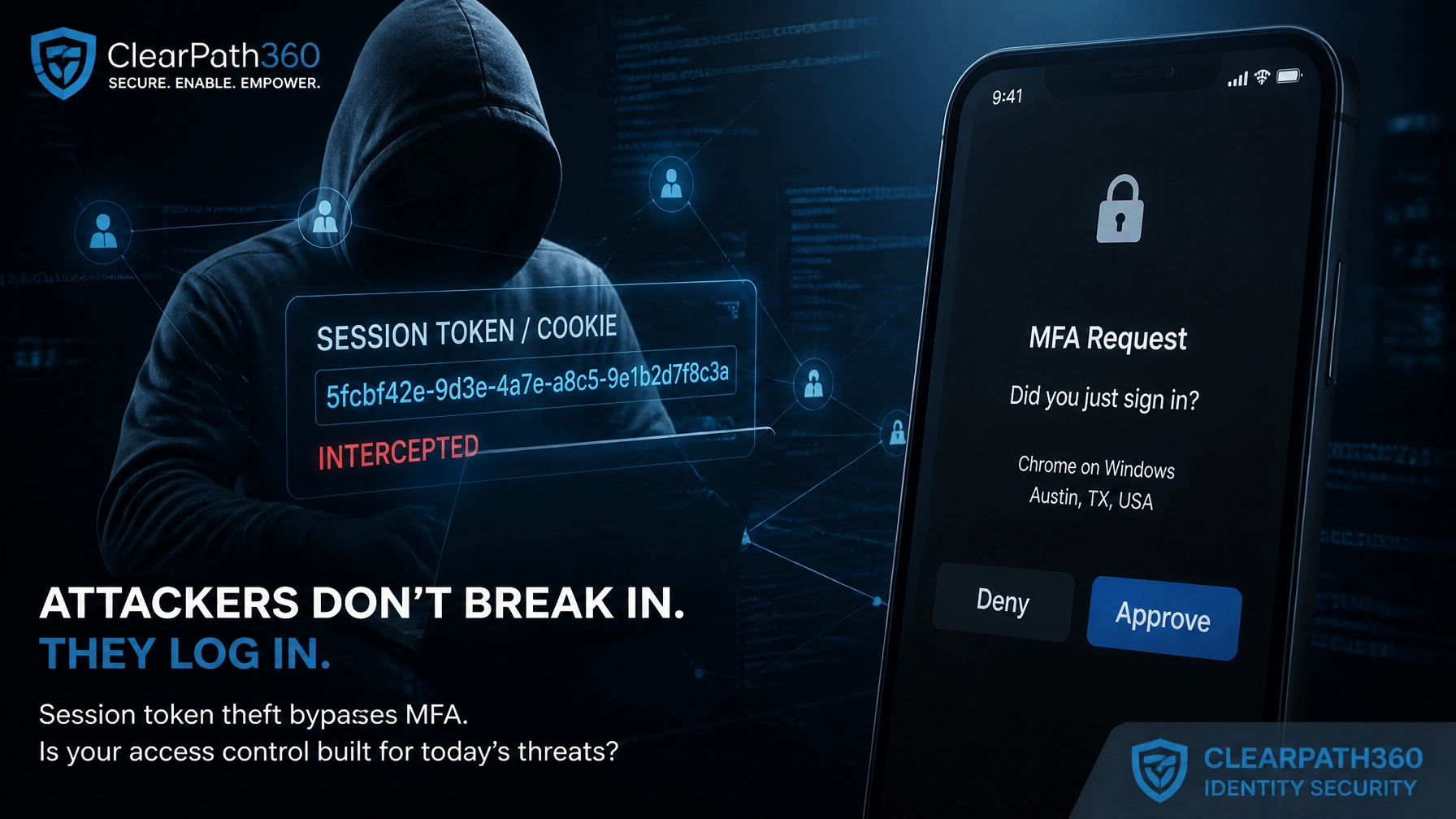
Begin by acknowledging that simple passwords are a relic of the past. In 2026, underwriters require MFA across every entry point: not just your email. This includes your financial systems, your remote access portals, and even your administrative accounts for internal software.
"True security isn't found in a single lock, but in the layers of defense that make a breach statistically improbable." : ClearPath360 Wisdom
Share this with your team: MFA is the most cost-effective way to lower your insurance premiums. If you aren't using non-SMS-based authentication (like authenticator apps or physical keys), your application might be rejected before it even reaches a human reviewer.
2. EDR and XDR are the New Minimum
This is where you move from passive defense to active hunting. Standard antivirus software is no longer sufficient for 2026 compliance. Insurers now mandate Endpoint Detection and Response (EDR) or Extended Detection and Response (XDR). These systems don't just wait for a known virus; they analyze behavior to stop "zero-day" attacks in their tracks.

As you move toward a more secure infrastructure, consider how Managed IT Services can provide the 24/7 monitoring required to back up these tools. Carriers want to see that if an alert fires at 3:00 AM on a Sunday, someone is there to respond.
3. Immutable and Offline Backups
Use this space to rethink your disaster recovery. In previous years, having a cloud backup was enough. Today, the rise of "wiper-ware" and sophisticated ransomware means your backups must be immutable (unable to be changed or deleted) and, ideally, offline.
Strike a balance between accessibility and security. Your insurance carrier will ask for documented proof of annual restore tests. It isn't a backup if you can't prove it works when the pressure is on. Check out our Data Backup and Recovery page for more on building a resilient vault.
4. The Intelligent Sentry: Behavioral Detection
Maintain a focus on the cutting edge. 2026 is the year where "The Intelligent Sentry" becomes a standard part of the security conversation. This refers to AI-driven systems that detect anomalies in user behavior.
Begin by identifying who has access to your sensitive data. If a user who usually logs in from Grand Blanc suddenly attempts to download a database from an IP address in another country, your system should automatically lock them out. This proactive protection is exactly what insurers want to see in a high-value policy.
5. Network Segmentation for Surveillance
As you integrate more physical security, you must be careful not to create digital backdoors. Many businesses in Genesee County are upgrading to advanced surveillance systems, but these devices often live on the same network as your credit card processing.

As a proud Axis Communications Silver Partner, we recommend segmenting your camera network entirely. Use directive language with your IT provider: "Isolate our VMS (Video Management System) from our core business data." This prevents a compromised camera from becoming a gateway to your payroll.
6. Incident Response (IR) Tabletop Exercises
Keep your language focused on preparedness. A written Incident Response plan is a great start, but in 2026, insurers want proof that you’ve practiced it.
Schedule a "Tabletop Exercise" where your leadership team walks through a simulated breach. This is where you find the gaps in your communication and decision-making before a real crisis hits. It captures the reader’s interest to know that a well-documented IR plan can reduce insurance costs by up to 20%.
7. Public Safety and the 911 Camera Share Initiative
This is a specific opportunity for Genesee County businesses to lead. Local law enforcement has launched the 911 Camera Share initiative, allowing businesses to grant emergency access to their external feeds during a crisis.

Participating in such programs not only enhances community safety but demonstrates to insurers that you are integrated into a professional security ecosystem. It shows that your network security isn't just about protecting your own files, but about being a resilient part of the Flint and Genesee community.
8. Weapon Detection for Schools and Churches
As you move toward more specialized safety needs, consider the impact of AI weapon detection. For schools and churches, this is no longer science fiction: it is a practical tool that saves lives and lowers liability.
By integrating weapon detection into your existing surveillance feeds, you provide an early warning system that traditional security guards cannot match. Insurers value the reduction in "seconds to respond," which significantly lowers the risk profile of high-occupancy buildings.
9. Employee Phishing Simulations
Share the responsibility of security with your entire staff. Human error remains the #1 cause of data breaches. 2026 compliance requires more than a once-a-year training video.
Use this space to implement monthly phishing simulations. These controlled tests show you which employees are most likely to click a malicious link, allowing you to provide targeted coaching. Documented training results are a "must-have" for your cyber insurance folder.
10. Managed IT: The 360-Degree Shield
End by looking at the big picture. Compliance isn't a one-time event; it’s a constant state of readiness. Most small to medium-sized businesses find it impossible to keep up with these 10 points while also running their core operations.

This is where a Managed IT partner becomes your greatest asset. At ClearPath360, we don’t just fix broken computers; we build the resilient infrastructure that insurers demand. We integrate your digital security with your physical surveillance, ensuring that your 2026 compliance isn't just a hurdle you jumped over, but a foundation you built on.
As you look toward your next insurance renewal, remember: the goal isn't just to get covered: it's to be secure. By following these directive steps, you position your business as a leader in Genesee County's digital and physical safety.