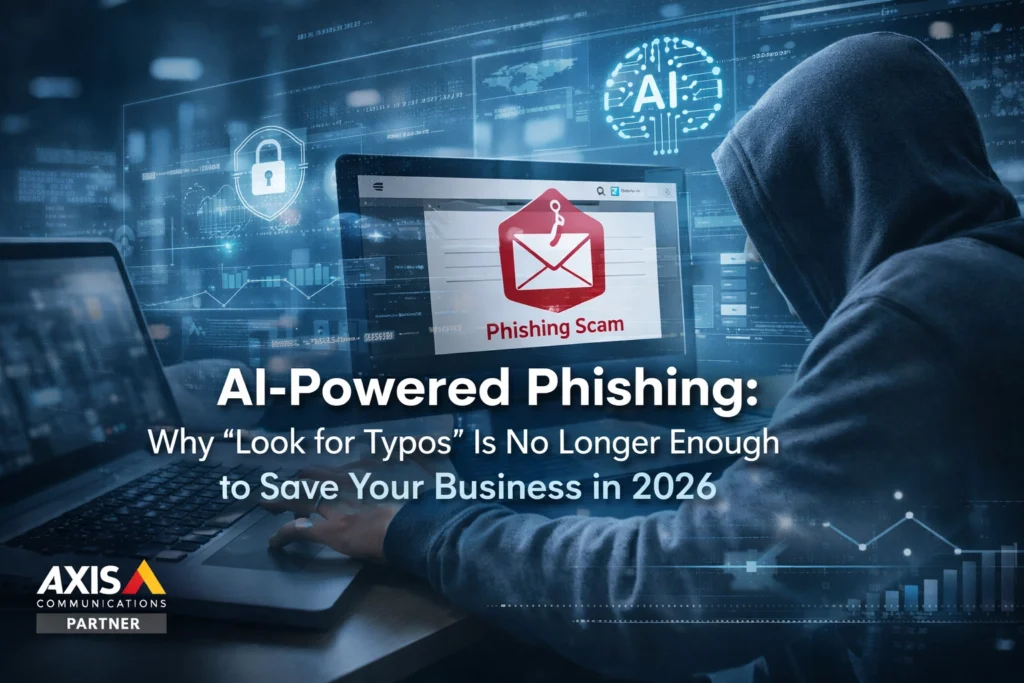
Remember when spotting a phishing email was as simple as looking for misspellings and bad grammar? Those days are gone: and they're not coming back.
Begin by acknowledging a hard truth: the advice you've been giving your team about identifying phishing emails is now obsolete. In 2026, artificial intelligence has fundamentally transformed how attackers craft their schemes. We're no longer dealing with poorly-written scams from overseas. We're facing perfectly personalized, grammatically flawless attacks that arrive every 19 seconds: more than double the pace from just two years ago.
This is your wake-up call to understand why traditional phishing detection has failed, and more importantly, what you need to do about it before your small business becomes the next statistic.
The AI Revolution Made Phishing Invisible
Start by understanding the scale of what's changed. Between September 2024 and February 2025, cybersecurity researchers analyzed thousands of phishing emails and found that 82.6% contained AI-generated content. That's not a typo: more than four out of five phishing attempts now use artificial intelligence to craft their messages.
What does this mean for your business? It means attackers can now compose emails in flawless English (or any language), research your company's organizational structure, reference recent projects your team worked on, and personalize each message based on the recipient's job role and social media activity. The Nigerian prince with his broken English has been replaced by AI that writes better than most of your own employees.

Consider what happens when technology eliminates the human element that made phishing detectable. Your team can no longer rely on their instincts about "something seeming off" when the grammar is perfect, the logo looks authentic, and the sender appears to know intimate details about your business operations.
Why Every Defense You Built Is Now Compromised
Use this section to examine how attackers have systematically dismantled every traditional security measure you thought protected your business.
Pattern-matching is dead. Your email filters look for known malicious URLs and file signatures. But here's the problem: 76% of initial infection URLs in modern phishing attacks are completely unique: they've never appeared in any previous campaign. Another 82% of malicious files have unique digital fingerprints. Your security tools literally can't recognize threats they've never encountered before.
Email authentication isn't enough. SPF, DKIM, and DMARC protocols verify that emails come from legitimate domains. Attackers now compromise actual business accounts or register domains that look identical to trusted ones. When an email technically passes all authentication checks, your filters let it through.
User awareness training has hit a wall. You've trained your team to spot red flags. But when AI generates emails that reference real projects, use appropriate business terminology, and arrive at contextually relevant times, what red flags are left to spot? The warning signs your team learned to recognize simply aren't there anymore.

"Traditional perimeter defenses can't keep pace with threats that shape-shift after delivery." : Josh Bartolomie, Chief Security Officer at Cofense
Strike a balance between acknowledging the severity of the threat and maintaining hope that effective solutions exist. This isn't about creating panic: it's about motivating the right action.
What Modern Phishing Actually Looks Like in 2026
Share real-world examples your team needs to recognize. Modern AI-powered phishing doesn't announce itself with obvious mistakes.
The personalized vendor invoice. You receive an email from your office supply vendor requesting payment. The logo is perfect. The invoice number follows their usual format. It references your last order by date and product. The only problem? The payment portal link leads to a credential harvesting site that looks identical to the real thing. The attacker scraped your vendor relationship from LinkedIn and mimicked everything down to the account manager's email signature.
The urgent IT security alert. Your team gets a message from "IT" about a critical security update that needs immediate action. It uses your company's exact internal terminology. It references recent system maintenance. The urgency feels appropriate given current cybersecurity threats. But clicking the link installs malware that gives attackers access to your entire network.
The executive request. An employee receives what appears to be a message from the CEO asking for confidential financial data "for the board meeting this afternoon." The email comes from a compromised executive account, uses the CEO's typical writing style, and creates time pressure that bypasses normal verification procedures.
These aren't hypothetical scenarios. This is what's hitting businesses just like yours right now, and at a pace of one attack every 19 seconds across the business landscape.
The Real Cost for Small Businesses
Move beyond abstract threats to concrete consequences. When a phishing attack succeeds against your small business, you're not just dealing with a compromised email account.
Begin with the immediate financial impact. The average cost of a successful phishing attack for small businesses now exceeds $140,000 when you factor in ransom payments, system recovery, lost productivity, and emergency IT response. That's a number that could cripple or close most small operations.
Then consider the cascading effects. Customer data breaches trigger notification requirements, potential lawsuits, and loss of business relationships. Employees lose trust in your security. Your reputation in the community suffers. Insurance premiums increase. Some clients may require proof of enhanced cybersecurity before continuing to work with you.
Keep your focus on the preventable nature of these consequences. This isn't about living in fear: it's about recognizing that the traditional "look before you click" approach no longer provides adequate protection for modern small business operations.
How ClearPath360's Layered Defense Actually Works
This is where you understand what protection looks like when "looking for typos" isn't enough. At ClearPath360, we've built managed IT services and cybersecurity around the reality that AI-powered threats require AI-powered defenses backed by human intelligence.
Post-delivery threat detection extends beyond your email gateway. Even when malicious emails bypass initial filters (and they will), our systems continuously monitor for suspicious behavior patterns after delivery. We catch threats that your perimeter defenses miss.
Behavioral analysis watches what happens after someone clicks. If a user suddenly starts accessing files they've never touched, communicating with unusual external contacts, or exhibiting other anomalous patterns, our systems flag it immediately: often before the employee realizes they've been compromised.
Real-time threat intelligence means we're analyzing phishing attempts across our entire client base. When one business gets targeted with a novel attack, we immediately update protections for everyone. You benefit from collective defense intelligence, not just your own experience.

Human verification layers add critical context that automated systems miss. Our managed IT team reviews flagged emails, confirms legitimate business communications, and quarantines actual threats before they can spread through your network.
Employee reporting mechanisms turn your team into an active defense layer. When something feels wrong (even if they can't articulate why), they can report it instantly for expert analysis. This combines human intuition with professional verification.
What You Need to Do Right Now
Use this moment to take immediate action. Understanding the threat doesn't protect you: changing your approach does.
Audit your current email security. If you're relying solely on built-in protections from Microsoft 365 or Google Workspace, you're vulnerable. These platforms provide basic security, but they weren't designed for AI-powered, polymorphic attacks that change characteristics after delivery.
Schedule a cybersecurity assessment with a managed IT provider who understands modern threats. You need an honest evaluation of where your defenses fall short and what specific vulnerabilities exist in your current setup. At ClearPath360, we conduct these assessments specifically for small businesses operating in the 2026 threat landscape.
Implement layered defenses that assume some attacks will get through. Your security strategy needs detection and response capabilities, not just prevention. This includes monitoring user behavior, maintaining offline backups, and having incident response procedures ready before you need them.
Update your employee training beyond "look for typos." Your team needs to understand that grammatically perfect, highly personalized emails can still be malicious. They need verification procedures for financial requests, data access, and urgent IT communications: even when those requests appear to come from legitimate sources.
As you move forward, remember that effective cybersecurity for small business IT isn't about perfection: it's about having multiple layers that work together so that when one fails, others catch what gets through.
The advice to "look for typos" served us well for years. But in 2026, your business needs protection designed for threats that don't make mistakes anymore. Your employees can't be expected to identify what's become virtually indistinguishable from legitimate communication.
That's where proactive managed IT services create real value: by implementing the layered defenses, continuous monitoring, and expert response capabilities that catch what the human eye can't.
Your next phishing email won't have typos. It might arrive in the next 19 seconds. Make sure your defenses are ready.